

Long before interactive whiteboards, digital calculators, and classroom tablets, American students encountered an assortment of mechanical devices that made everyday lessons possible. Some required careful handling, while others involved unfamiliar sounds, chemicals, and complicated procedures. From hand-operated copying machines to mathematical instruments without batteries, many forgotten classroom essentials reveal how dramatically school life has changed.
Mimeograph Machines: When Making Copies Required Ink and Stencils
Before photocopiers became standard classroom equipment, teachers often relied on mimeograph machines to reproduce worksheets, assignments, and announcements. These devices used specially prepared stencils that allowed ink to pass through selected areas onto sheets of paper. Creating a stencil required a typewriter or another suitable writing instrument, while producing copies involved operating the machine and managing its ink supply.
The process could become messy, particularly when preparing large quantities of classroom materials. Unlike modern printers, which produce documents from digital files, mimeographs demanded considerable preparation and hands-on attention (source). Today’s students might find it surprising that producing a stack of worksheets once involved preparing a physical stencil, loading ink, and operating mechanical equipment rather than clicking a print button.
Spirit Duplicators: The Mystery of Purple Worksheets
Another familiar copying device was the spirit duplicator, commonly called a ditto machine. Although often confused with mimeographs, spirit duplicators used a different printing method. Teachers prepared master sheets containing transferable dye, which was reproduced onto paper using a special duplicating fluid. The resulting worksheets frequently featured purple lettering rather than conventional black ink.
These copies became memorable for their distinctive chemical smell, particularly when freshly distributed. Students sometimes held the sheets close to their faces to experience the unusual scent. For younger generations, the idea that printed assignments once arrived with purple lettering and a noticeable odor may seem particularly strange. Unlike digital printing, the ditto process also limited the number of clear copies obtainable from a single master (source).
Filmstrip Projectors: Pictures That Advanced With a Bell
Filmstrip projectors brought visual lessons into classrooms without requiring television screens or computers. Instead of displaying continuous moving images, these devices projected individual photographs or illustrations arranged sequentially on a strip of film. Teachers could advance the presentation manually, controlling how long students examined each picture.
Many educational filmstrips included narration recorded on phonograph records. An audible signal indicated when someone should move the film to the next image, creating a presentation that depended on coordination between sound and projected pictures.
Operating the projector became an enjoyable classroom responsibility for some students. Nevertheless, its mechanical controls and frame-by-frame presentation would be unfamiliar to anyone accustomed to streaming video. Filmstrip projectors remained popular for decades before videocassette technology increasingly replaced them during the 1980s (source).
Overhead Projectors: Writing on Sheets of Transparent Plastic
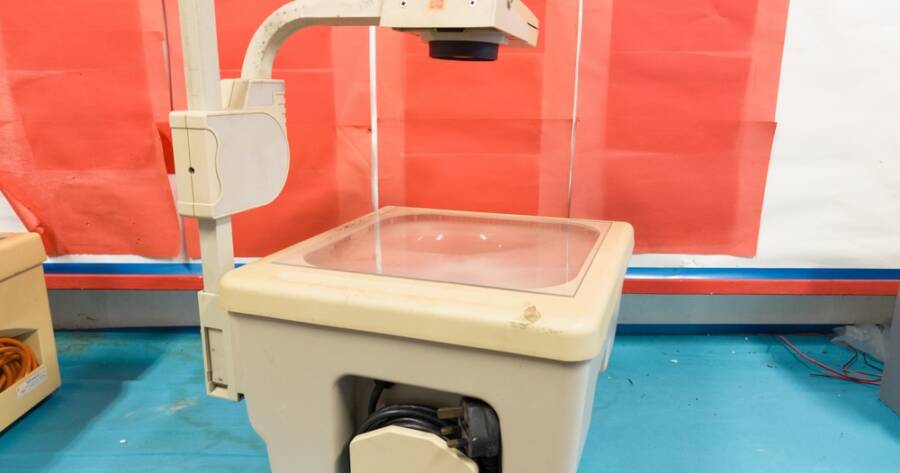
Overhead projectors allowed teachers to display handwritten notes, diagrams, and illustrations directly onto classroom screens. The devices used a bright light beneath a transparent surface, with mirrors and lenses directing enlarged images toward a wall. Teachers placed clear plastic sheets over the illuminated platform and wrote on them using suitable markers.
The technology became increasingly prominent during the 1960s. Early classroom models developed by Roger Appeldorn’s team at 3M helped establish overhead projection as an important teaching method. The company began producing its improved projectors in 1962, and the devices eventually became widespread educational tools (source).
Unlike today’s digital presentations, preparing overhead materials involved arranging physical transparencies and maintaining specialized equipment. Reusable sheets often required wet-erase markers, while the projector’s hot bulb demanded careful handling. Students unfamiliar with this technology might be particularly puzzled by the idea of presenting information through handwritten plastic overlays.
Slide Rules: Solving Mathematics Without Electronic Calculators
Before inexpensive electronic calculators became widely available, students studying advanced mathematics and science sometimes used slide rules. These instruments featured numbered scales that moved against one another, allowing users to perform calculations through carefully aligned measurements.
Slide rules could handle multiplication, division, square roots, and other mathematical operations. However, using them effectively required knowledge of logarithmic relationships and an understanding of how to interpret approximate answers. Unlike modern calculators, they did not automatically display a complete numerical result.
Slide rules were particularly familiar in technical education during the 1950s and 1960s. They eventually declined as electronic calculators became more affordable and accessible (source). For modern students, the idea of solving complicated equations using sliding numerical scales rather than buttons or screens may be one of the most bewildering aspects of historical classroom technology.
Chalk Liners: Drawing Perfect Lines on Blackboards
Even ordinary blackboard lessons sometimes required specialized equipment. Chalk liners allowed teachers to draw several parallel lines simultaneously, particularly for music instruction and handwriting exercises. Rather than repeatedly measuring distances with a ruler, instructors could produce evenly spaced guides in a single movement.
The tool was especially useful when drawing musical staffs or preparing structured writing demonstrations. However, its purpose might not be immediately apparent to students accustomed to digital whiteboards, where lines can be generated instantly.
Chalk liners demonstrate how even seemingly simple classroom activities once benefited from mechanical solutions (source). Their usefulness depended on an educational environment where blackboards, chalk, and handwritten demonstrations were central to everyday lessons.
What These Forgotten Classroom Tools Reveal About Education
The classroom tools of the 1960s illustrate how much preparation, coordination, and practical skill once went into everyday teaching. Mimeographs produced assignments through ink and stencils, filmstrip projectors required manual advancement, and slide rules helped students calculate answers without electronics.
Although these devices may seem complicated today, they served important educational purposes and represented useful innovations in their time. Exploring how they worked offers a fascinating perspective on the evolution of classroom technology and reminds us that familiar modern conveniences replaced systems that earlier generations had to learn, maintain, and operate themselves.