

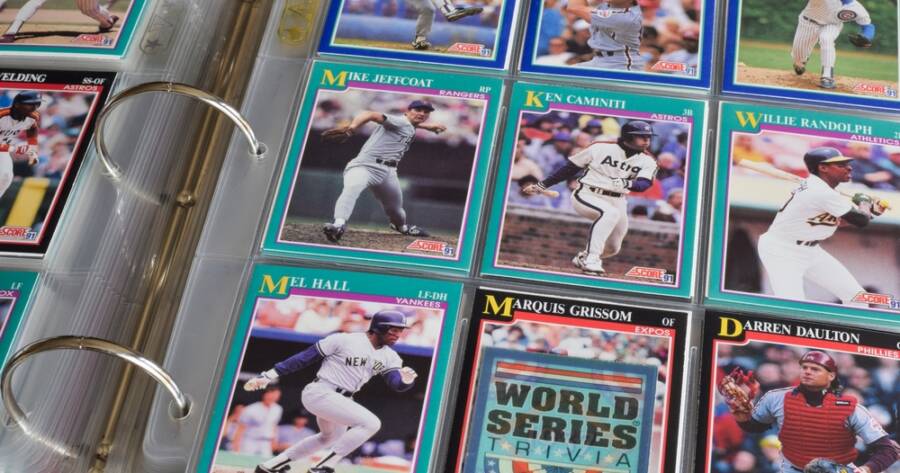
Most baseball cards from the 1990s were produced in enormous quantities, which left many collections worth far less than owners once expected. A small group of cards, however, has broken away from the pack. Rare errors, limited distributions, condition-sensitive releases, and high-grade examples can still command hundreds or even thousands of dollars in today’s collector market.
Why Some 1990s Baseball Cards Are Still Valuable
Much of the late 1980s and early 1990s is associated with the so-called Junk Wax Era, when manufacturers produced huge quantities of baseball cards and dramatically reduced the scarcity of ordinary releases. As a result, many familiar cards from the period remain inexpensive even decades later.
The exceptions usually have something that separates them from ordinary cards. Printing errors, limited distribution, difficult-to-find high grades, important rookie appearances, and early premium inserts can all create genuine scarcity. Condition is especially important, so two copies of the same card can have dramatically different values depending on professional grade, authenticity, and recent collector demand.
1. 1993 SP Derek Jeter Foil Rookie #279
The 1993 SP Derek Jeter #279 is one of the most recognizable baseball cards of the decade and one of the toughest modern rookie cards to find in elite condition. Its dark edges and foil surface show wear easily, which makes high-grade examples significantly more valuable than lower-grade copies. PSA describes the card as particularly challenging in Mint condition because many examples show edge and surface wear even when pulled from packs (source).
Recent October 2026 sales show how much condition matters. PSA 8 examples have sold for roughly $500 to more than $600, while PSA’s pricing data places much larger premiums on PSA 9 and PSA 10 copies. Only 22 examples had received a PSA 10 grade in the population data shown by PSA, reinforcing why the best-preserved copies occupy an entirely different price tier (source).
2. 1990 Topps Frank Thomas No Name on Front #414
The ordinary 1990 Topps Frank Thomas rookie is easy to find, but the rare “No Name on Front” version is a completely different collectible. A printing error left Thomas’s name off the front of a small number of cards, creating one of the most famous error cards of the Junk Wax Era. Authentic examples can sell for thousands of dollars even without receiving one of the highest possible grades.
PSA sales data illustrates the difference. A PSA 5 example sold for $13,750 in September 2026, while a PSA 8 sold for $32,499.99 in August. PSA’s population report also shows how scarce the error remains compared with the standard version of the card (source). At the extreme end of the market, a PSA 10 copy sold for $183,000 at Heritage Auctions in March 2026, setting a record for a Frank Thomas card (source).
3. 1990 Bowman Barry Bonds #181
The standard 1990 Bowman Barry Bonds card may not look especially rare at first glance, but top-grade copies have attracted renewed collector attention. Sports Illustrated reported in March 2026 that only 221 examples had been graded by PSA at that point, with just 44 receiving a PSA 10. That relatively small high-grade population helped separate pristine copies from the many inexpensive cards produced during the same era (source).
A PSA 10 sold for $85.87 in February 2026 after comparable sales had been closer to $20 only a few months earlier (source). The dollar amount is modest compared with the Frank Thomas or Jeter cards, but the rapid increase shows why collectors pay attention to population reports and condition. A common-looking card can become considerably more desirable when very few copies survive at the highest grade.
4. 1997 Flair Showcase Hot Gloves Mike Piazza #11
The Mike Piazza card worth watching is more specific than a standard 1997 Flair Showcase release. It is the 1997 Flair Showcase Hot Gloves #11 insert, a visually distinctive card that was inserted at approximately one per 90 packs. Its scarcity, premium design, and Piazza’s popularity have helped high-grade copies attract renewed interest from collectors (source).
A PSA 9 example sold for $142 in February 2026 after a comparable copy had sold for $33 in November 2025. That represents a substantial increase over a short period, although collectors should remember that individual card prices can move quickly. The value here comes from a combination of insert scarcity, condition, player demand, and the distinctive premium-card designs that defined the later 1990s.
5. 1991 Topps Desert Shield Randy Johnson #225
The 1991 Topps Desert Shield set looks similar to ordinary 1991 Topps cards, but its distribution history makes it far scarcer. The special cards were sent to U.S. military personnel serving during the Gulf War and feature a Desert Shield emblem on the front. Sports Illustrated reports an estimated production of roughly 7,000 copies per player, a tiny number compared with the enormous quantities of standard Topps cards produced during the era (source).
Randy Johnson’s #225 card has benefited from that limited distribution and his standing as one of baseball’s most dominant pitchers. A PSA 8 example sold for $199 in March 2026, compared with $99 in July 2025. Authenticity is especially important with Desert Shield cards because their premium over ordinary 1991 Topps versions makes them attractive targets for misidentification and counterfeit concerns.
6. 1992 Bowman Mariano Rivera Rookie #302
Mariano Rivera’s 1992 Bowman #302 remains desirable because it is an important early card of a Hall of Fame closer, not because PSA 10 examples are extraordinarily rare. PSA currently reports more than 1,600 copies in the Gem Mint 10 grade, along with thousands more in PSA 9. That makes Rivera’s card different from several others on the list, where extremely small grading populations are a major part of the appeal (source).
Demand nevertheless remains strong. PSA records show PSA 10 examples selling for $700 and $850 in October 2026, while recent PSA 9 copies have generally sold in the low-$100 range (source). Rivera’s legendary career, rookie-card status, and continued popularity among Yankees collectors help support prices even though the card is considerably more available in high grade than some other valuable 1990s releases.
7. 1994 Topps Finest Refractor Don Mattingly #392
Early Topps Finest Refractors hold an important place in hobby history because they helped establish the shiny parallel cards that would become a major part of modern collecting. Don Mattingly’s 1994 Topps Finest Refractor #392 combines that early refractor appeal with the lasting popularity of one of the most recognizable Yankees players of his generation.
Sports Illustrated reported that a PSA 8 copy sold for $155 in February 2026, up from $45 in December 2025. At the time of the report, only 63 copies had been graded by PSA, adding genuine scarcity to the card’s historical importance (source). The combination of a small graded population, condition sensitivity, early refractor technology, and Mattingly’s collector following makes it one of the more interesting overlooked cards from the decade.
Condition Can Make the Difference Between a Common Card and a Valuable One
The 1990s produced millions of baseball cards, so age alone does not make a card valuable. The strongest prices usually belong to unusual errors, limited releases, desirable rookies, scarce inserts, or copies that survive in exceptional condition. Professional grading can also create enormous price differences, particularly when only a small number of cards receive the highest grades.
Anyone sorting through an old collection should identify the exact card, variation, and condition before assuming what it is worth. Recent completed sales and current grading population reports are generally more useful than asking prices alone. A box filled with ordinary Junk Wax cards may still be worth very little, but the right error, rookie, Desert Shield issue, or early refractor can make checking carefully worthwhile.