

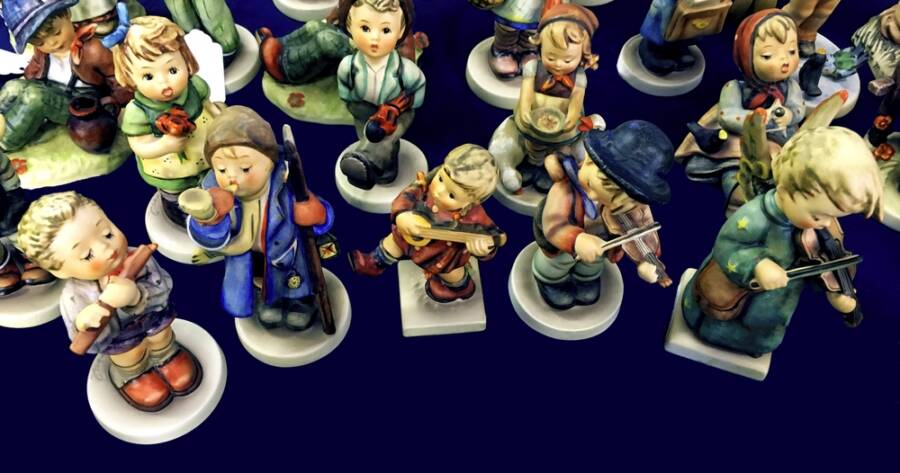
Porcelain figurines can range from inexpensive decorative pieces to highly sought-after collectibles, and small details often make an enormous difference in value. Maker, production era, base marks, rarity, condition, and provenance can all influence what buyers are willing to pay. Learning what to examine first can help collectors recognize when an ordinary-looking figurine deserves a closer look.
Hummel Figurines: Trademark Eras Define the Price
Few collectible figurines carry the name recognition of Hummels. Originally introduced by the Goebel factory in Germany and based on artwork by Sister Maria Innocentia Hummel, these charming childhood-themed pieces became enormously popular with American servicemen stationed in postwar Germany, who brought them home and sparked a widespread collecting craze that peaked in the 1980s (source). The Goebel factory ultimately produced them for over seven decades before closing in 2008 (source).
For collectors focused on the 1950s, the trademark mark on the base is the single most important identifier. The TMK-2 mark, known as the Full Bee, was used between 1950 and 1955, making it directly tied to that decade’s production run (source). However, the earlier Crown Mark, designated TMK-1 and used in the years just before and slightly overlapping the 1950s, is even more prized. A Crown Mark example of the same model can fetch five to twenty times more than an equivalent piece made under a later trademark (source). Large figurines such as “Apple Tree Boy” and “Apple Tree Girl” bearing Crown Marks have sold for more than $26,000, and models like “Adventure Bound” (#347) carry estimated values reaching nearly $5,000 (source).
Boehm Porcelain: America’s Most Prestigious Postwar Studio
While European makers tend to dominate conversations about fine porcelain, Edward Marshall Boehm built one of the most respected porcelain studios in American history. He established his Trenton, New Jersey, workshop in 1950, and within just a year, the Metropolitan Museum of Art in New York had already acquired one of his pieces (source). His work eventually became notable enough to serve as diplomatic gifts presented to Queen Elizabeth II and Pope John XXIII (source).
Boehm’s bird and floral figurines from the 1950s occupy the top tier of the studio’s collectible output. Pieces made during his lifetime, from 1950 until his death in 1969, routinely command collector premiums five to ten times higher than later editions, and the 1950s pieces specifically are considered the rarest of all (source). The base marks from that earliest era, running from 1950 to 1958, are either incised or stamped with “Boehm” or “Boehm USA,” and some very early examples bear a hand-scratched mark rather than a formal stamp (source). These early marks are the clearest signal of authenticity and rarity. At auction, Boehm pieces range from under $100 for common later production to more than $10,000 for rare limited editions and early works, with the American Bald Eagle figurine typically bringing between $3,000 and $12,000 or more (source).
Meissen and European Prestige Porcelain
No conversation about valuable porcelain figurines is complete without Meissen, the German manufacturer widely regarded as the birthplace of European hard-paste porcelain. Founded in 1710, Meissen has maintained an exceptional reputation across centuries, and several extraordinary examples have sold at auction for $200,000 or more, with even relatively common pieces regularly bringing hundreds of dollars (source). A 1732 Meissen bird figurine by sculptor Kirchner sold at Christie’s in 2015 for over $1 million despite showing signs of restoration (source).
Royal Nymphenburg, another German maker with deep historical roots, also produces figurines that reach impressive prices. The finest examples regularly appear on platforms like 1stDibs at $10,000 or more, and Sotheby’s estimated a mid-18th-century Nymphenburg lady figurine at between roughly $122,000 and $184,000 (source). Dresden lace figurines, celebrated for their extraordinary delicacy, add another dimension to the European market — even small pieces with minor damage can bring $100 or more, while pristine multi-figure examples may be worth thousands (source).
What to Look for When Evaluating a Piece
Collectors and inheritors of old figurines should pay close attention to the base of any piece before drawing conclusions about its value. Manufacturer marks, model numbers, and production codes are printed, incised, or hand-scratched into the underside and tell a detailed story about when and where a piece originated. Earlier marks consistently indicate higher value across virtually every major porcelain brand.
Condition matters enormously as well. Chips, cracks, crazing, and prior restoration work all reduce value significantly, though extraordinarily rare pieces sometimes retain strong prices even with damage. Size is another factor: larger figurines within a given model line almost always carry higher values than smaller counterparts, particularly for makers like Hummel where size variations are well documented by model number. Provenance, meaning documented ownership history or exhibition records, can further elevate a piece’s appeal to serious buyers and auction houses.
Why You Should Learn More About 1950s Porcelain Figurines
The market for 1950s porcelain figurines rewards those who take the time to understand it. Whether the interest lies in Hummel’s trademark system, the early hand-scratched marks of Boehm’s first workshop years, or the centuries-old prestige of Meissen and Nymphenburg, every maker has its own language of value.
Pieces that appear ordinary to the untrained eye can turn out to be rare production examples from a pivotal decade in porcelain history. Consulting auction records, studying base marks carefully, and learning the key production eras for each major brand are all meaningful steps toward understanding what a figurine might actually be worth. The more deeply one engages with this subject, the better positioned one is to recognize genuine value when it appears.
Sources
LoveToKnow guide to the most valuable antique porcelain figurines and what makes them worth money
Lion & Unicorn auction house value guide for Boehm porcelain bird figurines and floral pieces
Lion & Unicorn comprehensive Hummel figurines value guide covering trademark eras and auction prices