

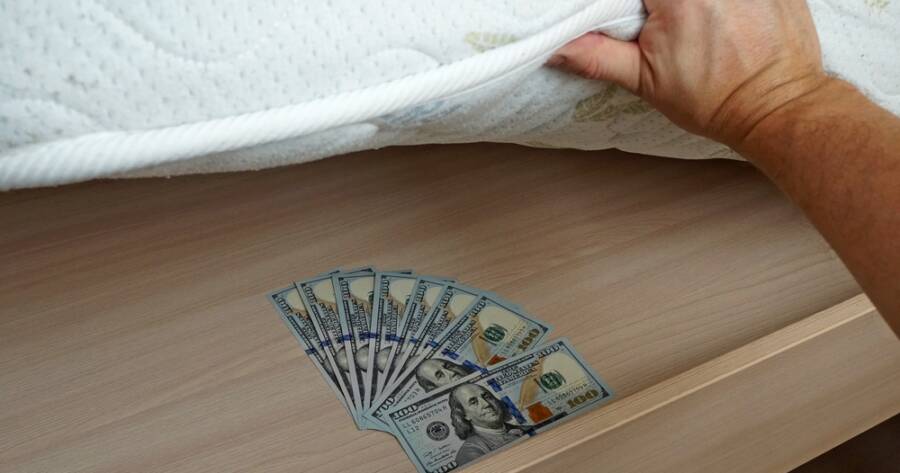
Keeping cash at home can be useful during emergencies, but choosing the wrong hiding place puts your money at risk. Some common spots are surprisingly easy for burglars to find, while others offer little protection against fire or damage. Understanding the three worst places to stash cash can help you keep your emergency savings safer.
Why Hiding Cash at Home Carries Real Risk
The instinct to keep physical cash somewhere accessible and hidden feels practical, but the reality is that most home hiding spots offer almost no real protection. Cash left around the house is vulnerable to theft, fire, flooding, and even simple misplacement. Unlike money sitting in a bank account, cash stored at home carries no federal insurance protection, meaning that if something goes wrong, that money is almost certainly gone for good (source).
Standard homeowners or renters insurance policies do cover some personal property losses, but cash is treated very differently from furniture or electronics. Most policies cap cash loss reimbursements at around $200, which means anyone storing hundreds or thousands of dollars at home is essentially taking on that financial risk entirely on their own (source). Understanding which specific hiding spots are the most dangerous is an important first step toward making smarter decisions about cash storage.
1) The Mattress and Bedroom Areas
Perhaps no cash-hiding location is more well-known than under the mattress. It has been a go-to spot for generations, and that familiarity is precisely what makes it so dangerous. Burglars are fully aware of this habit, and checking under or around the bed is one of the first things they do during a break-in (source). Jewelry, firearms, prescriptions, and extra cash are all commonly found in this area, making it a high-value target.
Surveys confirm this habit remains widespread, with a notable percentage of adults still choosing to keep their money in or under mattresses, beds, and pillows (source). Beyond theft, this location also poses a serious fire risk. A certified financial planner cited by CNBC warned that when a home is affected by fire, cash stored in scattered locations throughout the house could simply go up in flames with no recovery possible (source).
2) The Freezer and Kitchen Spaces
Tucking cash or valuables inside a plastic bag and placing it in the freezer became a widely known trick at some point, and now burglars know to check there too. The kitchen, in general, has become a popular area for people to stash valuables, but that popularity has made it a predictable target (source). Anyone relying on a freezer as a secure hiding place is likely overestimating how obscure that choice actually is.
Surveys back this up, showing that a segment of Americans store cash specifically in a freezer or refrigerator, apparently believing that burglars would skip the kitchen during a robbery (source). Beyond theft, a power outage or appliance failure introduces additional risk to any documents or paper currency stored in this location. It is a spot that feels creative but has long since lost any element of surprise.
3) Desk Drawers and Home Office Spaces
The home office is another area where cash and important documents frequently end up, and the organized nature of most desk setups actually works against the person trying to hide something. When drawers are labeled and orderly, it becomes easier, not harder, for a burglar to quickly identify where the most valuable items are located (source). Important papers and extra cash stored in office drawers are easy pickings during a fast-moving break-in.
Desk drawers also do nothing to protect cash from fire or water damage. A locked drawer might slow things down slightly, but it offers no meaningful protection against a determined thief or a household disaster. The home office might feel like a private space, but it is one of the first areas an intruder will search.
Smarter Alternatives for Storing Cash at Home
Financial experts generally recommend keeping only a modest amount of physical cash at home, enough to cover essential expenses for a short period of time during an emergency. One commonly cited benchmark is having enough on hand to cover bare necessities for approximately two months, with average monthly food and fuel costs for U.S. consumers running close to $1,000 (source). Any amount beyond what is genuinely needed for emergencies is typically better off in a federally insured bank account.
For cash that does need to stay at home, a fireproof safe that is bolted to the floor or a wall provides a meaningful layer of protection. A portable safe that can simply be picked up and carried away offers very little actual security, since burglars can easily take the entire unit with them (source). Deposits in FDIC-insured accounts provide protections that no home hiding spot can replicate, as financial planners consistently point out when discussing cash storage strategies (source).
Why Keeping Cash at Home Deserves More Attention
The risks attached to storing cash at home go beyond the obvious fear of burglary. Fire, water damage, and simple loss can all permanently eliminate money that has no insurance protection behind it. The three locations covered here, under the mattress, inside the freezer, and in desk drawers, are among the most commonly used and most consistently targeted spots in any home.
Recognizing these vulnerabilities is the starting point for making better decisions. Keeping only what is truly necessary for emergencies, securing it properly in a fixed safe, and placing larger savings in protected accounts are all steps that meaningfully reduce risk. Cash at home can serve a practical purpose, but only when it is stored with real awareness of the threats that exist.