

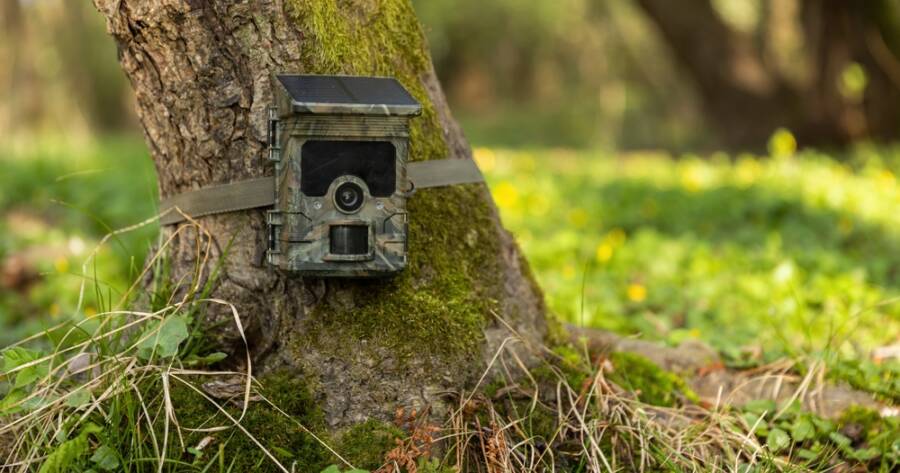
Trail cameras have opened a window into parts of the natural world people rarely get to see. Left quietly in forests, mountains, and other remote habitats, they have photographed elusive predators, confirmed species in unexpected places, and even helped prove that animals missing from scientific records for decades were still surviving far from human view.
How Trail Cameras Changed Wildlife Discovery
Remotely placed cameras equipped with motion and infrared sensors operate autonomously in the field, triggering whenever an animal moves through the frame with minimal human disturbance (source). This unobtrusive approach has made it possible to document species that would vanish the instant a researcher appeared on the scene. Dating back more than a century, camera trap technology has evolved dramatically, and the arrival of color photography pushed its popularity even further (source).
The impact of these tools extends well beyond professional researchers. Citizen scientists frequently mount trail cameras on trees in their backyards and share the resulting images with biologists, who can then compare findings across different regions and build a more complete picture of wildlife distribution (source). That collaborative model has made trail cameras one of the most powerful instruments in modern conservation.
The Coastal Marten: Rediscovered After Presumed Extinction
Few trail camera stories are as remarkable as the rediscovery of the coastal marten, also called the Humboldt marten, along the foggy forests of northern California. The species had been written off as extinct before a small surviving population turned up in 1996 (source). Even after that initial find, scientists struggled to understand how many individuals remained and where they lived.
A methodical deployment of 135 remote cameras across a 150-square-mile study zone—combined with 285 hair snares—ultimately identified 46 distinct individual martens through genetic analysis (source). Roughly the size of a ferret, the animal is so secretive that only four isolated populations are currently known to exist according to the U.S. Fish and Wildlife Service (source). Habitat loss, rodenticides, vehicle strikes, and disease continue to threaten the marten’s survival even today (source).
Bush Dogs Photographed in Unexpected Territory
Camera traps delivered another stunning revelation when they captured evidence of bush dogs living north of Panama for the very first time in 2017 (source). These compact, web-footed carnivores are among the least understood on the planet, and the images immediately gave scientists fresh data to work with. Without an automated camera quietly waiting in the jungle, the detection of a species this secretive in a region this far outside its known range might never have happened at all.
Attenborough’s Long-Beaked Echidna Reappears After 62 Years
One of the most remarkable camera-trap rediscoveries involved Attenborough’s long-beaked echidna in Indonesia’s Cyclops Mountains. The species had gone without confirmed scientific documentation for 62 years after a specimen was collected in 1961. Researchers deployed camera traps in 2022 and 2023, guided in part by Indigenous and local knowledge about where the animals might still survive. The 2023 survey produced 110 photographs from 26 independent camera-trap events, along with 15 videos, providing the first modern photographic evidence that the critically endangered species was still present (source).
The images did more than confirm survival. Researchers photographed multiple animals, including individuals displaying what appeared to be courtship behavior, suggesting that the population may still be reproducing. The findings were formally published in 2025 and also demonstrated how valuable local knowledge can be when scientists are searching for elusive species in difficult terrain. Indigenous communities had continued reporting sightings even while the animal remained absent from formal scientific records (source).
Silver-Backed Chevrotain Returns to Scientific View
The silver-backed chevrotain, sometimes called the Vietnamese mouse-deer, offers another striking example of what camera traps can reveal. Native to Vietnam, the small hoofed mammal had effectively been lost to science for almost three decades, with no confirmed wild photographs available. Researchers searching for the species eventually placed camera traps in forest habitat where local interviews suggested it might still survive, producing the first photographs of a living silver-backed chevrotain in the wild (source).
Those images confirmed that the species had not disappeared and gave conservationists a rare opportunity to begin studying its remaining population. The rediscovery was published in 2019 in Nature Ecology & Evolution, with researchers calling for immediate conservation action because so little was known about the animal’s numbers, distribution, and threats. The case showed how camera traps can transform local reports into verifiable scientific evidence when a species is too elusive for researchers to observe directly (source).
Why Rare Animals Are So Difficult to Document
Most rare or endangered species have low population densities, avoid open ground, and maintain territories that overlap minimally with human activity. Traditional survey methods, like direct observation, track surveys, and acoustic monitoring, all require researchers to be physically present in the right place at the right moment. A camera trap eliminates that constraint entirely, running continuously through weather, darkness, and difficult terrain without fatigue.
The scientific records these cameras produce are also verifiable in a way that reported sightings often are not. A timestamped photograph of a previously undocumented animal in a specific location provides concrete evidence that researchers can publish, share, and build upon. That evidentiary quality is precisely why conservation organizations around the world have incorporated trail cameras as a standard part of their fieldwork toolkit.
What These Findings Mean for Conservation
Each unexpected trail camera capture carries real-world consequences for how land is managed and protected. When bush dogs appear north of Panama or martens resurface in California forests, those images directly inform decisions about habitat corridors, protected area boundaries, and wildlife management policies. A single photograph can become the foundation for a new conservation plan.
The rediscoveries of Attenborough’s long-beaked echidna and the silver-backed chevrotain show how camera traps can confirm that elusive species are still surviving in places where scientists have struggled to document them. When combined with local knowledge and carefully targeted surveys, remote cameras can provide evidence that helps researchers decide where additional monitoring and conservation work may be needed (source).
Why You Should Learn More About Rare Wildlife and Trail Cameras Today
Trail cameras have redefined what is possible in wildlife science, turning remote forests, mountain slopes, and jungle undergrowth into open windows for observation. From the return of a coastal marten once feared lost, to bush dogs appearing north of their known range, to Attenborough’s long-beaked echidna and the silver-backed chevrotain reappearing after decades without confirmed scientific records, camera traps continue to reveal wildlife that might otherwise remain hidden.
Understanding how this technology works, and what it continues to uncover, offers a deeper appreciation for the hidden biodiversity still sharing the planet. The most astonishing trail camera photo may not have been taken yet, and the species in it may still be waiting to be named.