

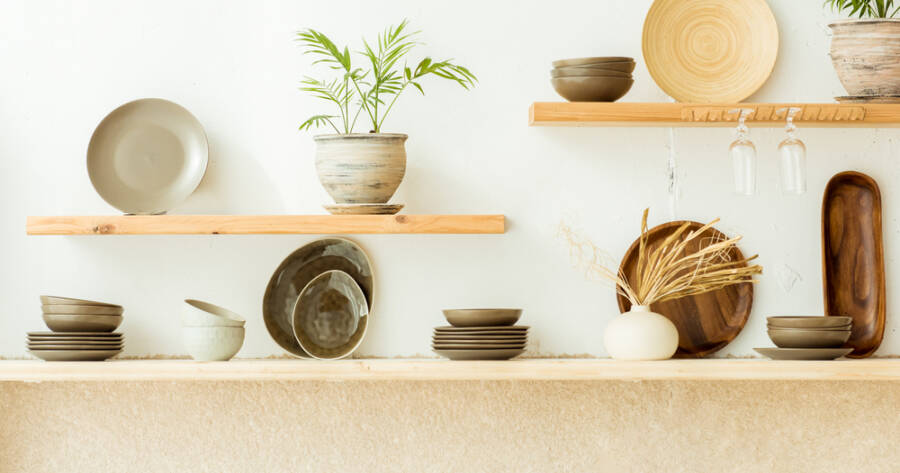
Kitchen cabinets are doing much more than storing dishes in 2026. Designers are treating them as major architectural and decorative features, while even the awkward space above them is getting more attention. Warmer materials, softer shapes, and more intentional styling are changing how kitchens look and feel, giving homeowners plenty of ways to refresh the room without starting from scratch.
Warmth and Natural Wood Are Taking Over
One of the strongest movements reshaping kitchen cabinetry right now is a collective turn toward warmth. Designer Corinne Ekle notes that trends are driven by natural wood finishes and a departure from the long-dominant all-white kitchen, with softer neutral tones like cream and mushroom stepping into the spotlight (source). This shift reflects a broader desire for kitchens that feel inviting rather than stark and clinical.
California-based kitchen designer Caren Rideau has observed a growing preference among clients for heavier wood species such as walnut, cherry, and deep-stained oak, all of which bring richness and visual depth to a kitchen’s overall character (source). These materials signal a move away from the minimalist, flat surfaces that defined kitchen design for much of the previous decade. Instead, the grain patterns and tonal variation inherent to natural wood are being celebrated as assets rather than imperfections.
Shape and Silhouette as Design Statements
Beyond material choice, the physical form of cabinetry is receiving renewed attention. Rounded cabinet profiles, once considered unusual, are now being embraced for the soft and playful quality they introduce into what is traditionally a rectilinear space. Designer Maggie Goodrich points out that shape and silhouette have emerged as genuine design features in their own right, not just afterthoughts (source). Curved door edges, arched cabinet openings, and softened corners all contribute to a more welcoming and less industrial aesthetic.
Another notable shift involves how upper and lower cabinets relate to each other architecturally. Designer Christopher Boutlier describes a growing interest in configurations where upper cabinets extend all the way down to the countertop surface, producing a hutch-like silhouette that reads more like a built-in furniture piece than standard millwork (source). This approach gives kitchens a more considered, bespoke appearance that feels intentional and elevated.
Ditching Upper Cabinets for an Open, Airy Feel
Some homeowners and designers are taking an even bolder stance by eliminating upper wall cabinets entirely. Caren Rideau notes that more clients are choosing to remove upper storage in favor of a cleaner, less cluttered visual environment (source). This choice opens up wall space for other design elements, including open shelving, tile work, or decorative accents, while also making kitchens feel larger and more breathable. The tradeoff in storage capacity is often offset by the gain in visual spaciousness and design flexibility.
Making the Most of the Space Above Cabinets
For kitchens that retain upper cabinetry, the zone between cabinet tops and the ceiling frequently goes underutilized. Interior designers who specialize in this space recommend treating it as a curated display area rather than dead space. New York designer Megan Pflug suggests placing vintage ceramic vases and other found objects in this zone, noting they offer easy maintenance and that adding a small lamp there is “so unexpected and helps to create a cozy mood” (source).
Textural contrast is another effective tool for above-cabinet styling. Designer Samantha Stathis Lynch recommends introducing items with varied surfaces, such as antique wooden cutting boards or other vintage pieces, to counteract the sterility that kitchens can sometimes project and to add a sense of layering and history to the space (source). A mix of textures, whether rough-hewn wood alongside smooth ceramics or matte pottery beside metallic accents, prevents the display from feeling flat or uniform.
Wallpaper, Lighting, and Hardware as Finishing Touches
When ceiling height leaves very little room above the cabinets, design solutions must become more compact. Designer Tom Scheerer addressed this constraint by applying a botanical wallpaper above the cabinet line, which introduced brightness and visually connected the upper kitchen zone to the room’s broader color palette (source). This approach works particularly well in kitchens where statement tile or specialty finishes already occupy the backsplash area, since the wallpaper above creates a cohesive visual flow rather than competing with lower surfaces.
Hardware and tone play equally important roles in pulling a kitchen together. Designer Megan West demonstrated how floating shelves positioned between cabinetry can serve as transitional display zones when filled with complementary glassware and decor, with warm-toned hardware acting as the thread that ties all the elements into a unified composition (source). Honey bronze and brushed brass finishes, for instance, pair naturally with wood-toned cabinets and warm neutral paint choices, reinforcing the overall direction toward richer, more layered kitchen environments. Even small hardware updates can shift the perceived quality and character of an entire cabinet run.
Why You Should Learn More About Kitchen Cabinet Trends Today
Kitchen cabinet design is evolving in genuinely exciting directions, with natural wood tones, expressive shapes, and thoughtfully styled surfaces all contributing to spaces that feel more personal and lived-in. The area above cabinets, once an afterthought, is now recognized by top designers as prime real estate for vintage finds, curated textures, and unexpected lighting moments.
Whether a homeowner is planning a full renovation or simply looking to refresh what already exists, understanding current cabinet trends and above-cabinet styling strategies offers a practical path toward a more polished and cohesive kitchen. Staying informed about these developments helps inform smarter decisions around materials, finishes, and decorative choices that will remain relevant and satisfying well beyond the next design cycle.