

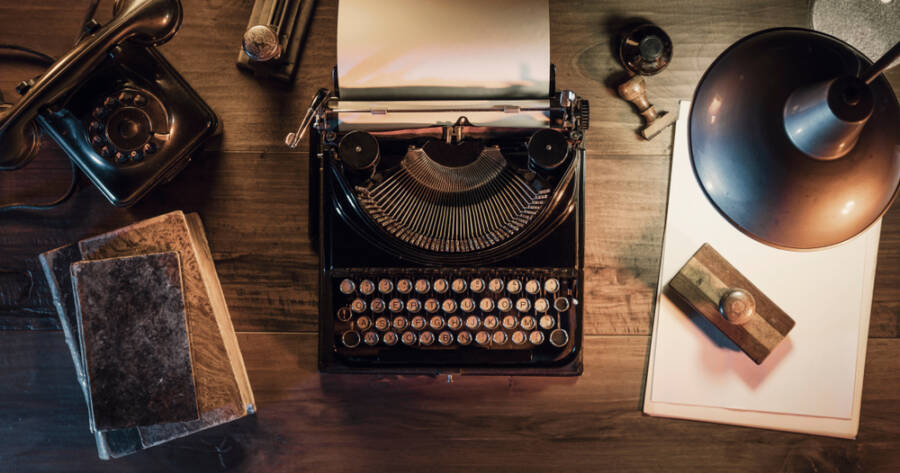
Before computers and smartphones transformed the workplace, American offices relied on an assortment of mechanical gadgets to keep daily operations running smoothly. From typewriters and rotary telephones to adding machines and Rolodexes, once-essential tools helped workers communicate, organize information, and complete administrative tasks. Nowadays, they offer a fascinating glimpse into the offices of previous generations.
The Typewriter: The Machine That Defined the Modern Office
Few inventions reshaped American working life as dramatically as the typewriter. The story begins in 1868, when Christopher Sholes, Carlos Glidden, and Samuel Soule secured a patent on a functional typewriter, with mass production starting at the Remington factory in Ilion, New York five years later (source). What started as a novelty quickly became indispensable. By World War II, the U.S. Army alone purchased one million typewriters, a figure that illustrates just how thoroughly the machine had embedded itself in American commerce and industry (source).
The typewriter’s peak form arrived with the IBM Selectric in 1961. Instead of traditional typebars, it used an innovative type ball mechanism that made it faster, quieter, and more reliable than anything before it. The Selectric went on to become the best-selling typewriter of all time, dominating the office market for decades (source). Today, a Selectric sitting on a vintage desk is a prized collector’s item, a reminder of an era when the rhythmic clatter of keys was the soundtrack of productivity.
Adding Machines and Calculators: Crunching Numbers the Hard Way
Before spreadsheet software made number-crunching effortless, office workers relied on adding machines to handle the heavy arithmetic. In 1888, William Seward Burroughs patented a device capable of accurately totaling long columns of figures and printing the results directly onto paper. The technology spread fast: within a decade, roughly 100,000 office workers across the country depended on these machines daily (source).
By midcentury, mechanical calculators had grown into towering, expensive electro-mechanical beasts packed with thousands of moving parts (source). Pulling a lever or pressing a key set off a cascade of spinning gears and rotating drums that produced a result in seconds. These machines demanded regular maintenance and a dedicated operator, making the calculator a symbol of serious business. The shift to compact electronic versions in the late 1960s and 1970s made all that mechanical complexity obsolete almost overnight.
The Rolodex, Dictaphone, and Other Daily Desk Staples
Networking meant something very physical in the mid-20th century office. The Rolodex, patented in 1956 by New York-based Zephyr American, offered a rotating wheel of indexed contact cards that let workers flip to any name or number in seconds (source). A well-stocked Rolodex was a genuine professional asset, and losing it could mean losing years’ worth of business relationships. The device became such a fixture that it entered the language as shorthand for one’s entire professional network.
The Dictaphone, trademarked in 1907, served a different but equally important function. Managers would speak correspondence aloud into the device, preserving their words on wax cylinders or magnetic tape, while dedicated typists later transcribed those recordings into finished documents (source). The workflow separated thinking from typing and kept executive time free for higher-level decisions. For decades, the Dictaphone defined how information moved from a manager’s mind to the printed page.
Mimeographs, Copiers, and the Art of Duplication
Reproducing documents was a labor-intensive affair long before the modern photocopier arrived. The mimeograph machine, which emerged in the 1890s, used a wax-coated master sheet to push ink through onto paper, allowing offices to produce roughly a hundred copies from a single original (source). School newsletters, office memos, and community bulletins all smelled faintly of mimeograph ink for most of the 20th century. Carbon copy paper played a parallel role, letting typists produce duplicate records of letters and contracts simultaneously with the original.
Everything changed when Xerox introduced the Haloid Xerox 914 in 1960. Despite early quirks like occasional paper scorching, the machine represented a fundamental leap forward, producing dry copies without messy inks or delicate master sheets (source). Within years, the photocopier became as essential as the telephone, transforming how offices shared information internally and with the outside world.
Rotary Telephones and Mechanical Date Stamps
Before smartphones and digital contact lists, rotary telephones were essential fixtures on office desks. Making a call required placing a finger into a numbered opening, rotating the dial, and allowing it to return before entering the next digit. The Western Electric Model 500, introduced in 1949, became a familiar example of this technology. Office workers used these phones to communicate with customers, suppliers, and colleagues, often keeping handwritten telephone directories or Rolodexes nearby. These mechanical devices eventually gave way to push-button telephones and digital communication systems (source).
Mechanical date stamps were another practical office gadget, especially in workplaces handling large quantities of paperwork. These handheld devices used adjustable mechanisms to print dates directly onto documents, helping employees organize correspondence, invoices, and administrative records. Workers could update the date manually and press the stamp against an ink pad before marking each page. Unlike modern document management software, which automatically records timestamps, these simple tools required physical handling and regular adjustment. Mechanical date stamps were widely associated with clerical work, providing an efficient way to track paperwork long before digital recordkeeping became standard (source).
From Mechanical Desks to Digital Everything
The long arc from typewriters to personal computers is a story of compression: tasks that once required specialized machines, trained operators, and considerable floor space gradually collapsed into a single desktop device. Data storage, correspondence, research, and report preparation, all once handled by dedicated tools and skilled workers, eventually became functions of a single computer terminal (source). The filing cabinet, the adding machine, and the typewriter joined the Rolodex and the mimeograph as relics of a world that moved more slowly but perhaps more tangibly.
What makes vintage desk gadgets so compelling today is not just nostalgia but a genuine appreciation for mechanical problem-solving. Each device represented the best thinking of its era, a human-engineered answer to a specific workplace challenge. Collectors, historians, and design enthusiasts continue to seek out these objects because they carry the fingerprints of generations who worked hard and expected their tools to work just as hard.
Why You Should Learn More About Vintage Office Technology
Exploring the history of vintage desk gadgets offers more than a trip down memory lane. These objects shaped the rhythms of American professional life for over a century, influencing everything from workplace hierarchy to how ideas moved between people. Understanding the tools that previous generations relied upon every day provides a richer perspective on the technology taken for granted now.
Whether the interest lies in collecting, design history, or simply appreciating how far the modern office has come, the story of these machines rewards curiosity. The Rolodex, the Selectric, the mimeograph, and their peers were not primitive stepping stones but sophisticated solutions to real human needs, and their legacy lives on in every digital tool used at work today.