

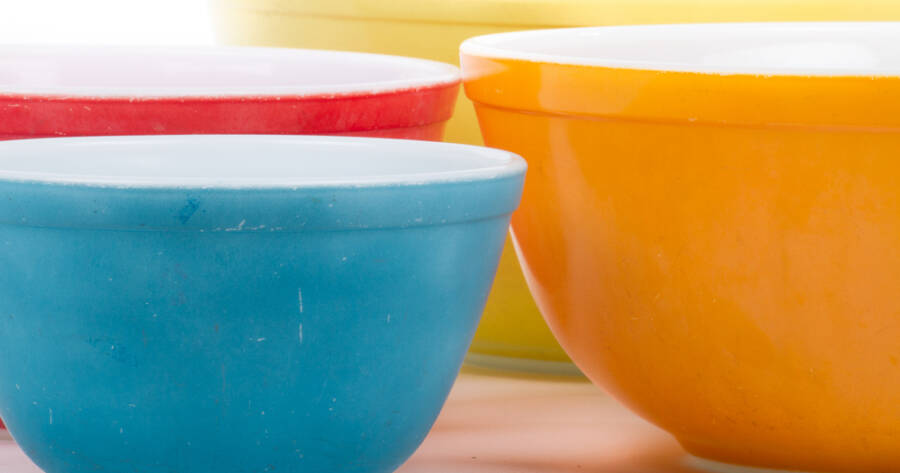
Glass bowls from the 1940s range from everyday kitchenware to distinctive pieces that remain sought after by collectors. Some are valued for recognizable makers, unusual colors, scarce patterns, or surviving sets, while others are common despite their age. Knowing which details point to genuine period production can make it much easier to separate an ordinary vintage bowl from one worth researching further.
Pyrex Primary Colors Mixing Bowls
One of the most recognizable glass bowl sets introduced during the 1940s is the Pyrex Primary Colors collection. Corning introduced the four-piece set in 1945 with yellow, green, red, and blue bowls made from white opal glass with colored exteriors. The original version was produced from 1945 through 1949 and was the first Pyrex opal-ware product to reach consumers (source).
Complete sets tend to attract more attention than single bowls, particularly when the color remains bright and the surfaces have not been heavily scratched or damaged. Auction results vary considerably with condition. A mixed lot containing a complete Primary Colors bowl set plus a refrigerator-dish set sold for $82 in 2024, while another auction record cited a Primary Colors nesting set that had previously sold for $725 in January 2025 (source) (source). A single green #403 bowl sold for $60 at auction in August 2026, showing how individual pieces can still have value when collectors need a specific size to complete a set (source).
Fire-King Jade-ite Bowls From the Late 1940s
Anchor Hocking’s Fire-King Jade-ite is another major name worth knowing. Its opaque jade-green color has become strongly associated with mid-century kitchenware, and several Fire-King Jade-ite lines were already in production by the late 1940s. Restaurant Ware dates from 1948, while other Jade-ite dinnerware lines appeared during the second half of the decade (source).
Values depend heavily on form, size, condition, and whether pieces remain together as a set. A single vintage Fire-King Jade-ite mixing bowl sold for $40 at auction in 2025, while a Jade-ite mixing-bowl set realized $80 in July 2026 (source) (source). Another 2026 sale of a Jade-ite swirl mixing bowl and batter bowl brought CAD $65 (source). Those prices show that not every Jade-ite bowl is a major windfall, but recognizable forms in good condition continue to attract collector demand.
Hazel-Atlas Bowls From the 1940s
Hazel-Atlas produced large quantities of household glassware, and some bowls from the 1940s remain collectible because of their color, pattern, and connection to Depression-era glass production. A recent auction identified a green Hazel-Atlas Rest Well mixing bowl as a known 1940s design. It appeared in a mixed glass lot that sold for $52 after 26 bids in 2026 (source).
Other Hazel-Atlas pieces can sell for modest amounts rather than hundreds of dollars. A pair of green Depression-era uranium-glass mixing bowls attributed to Hazel-Atlas sold for $25 in December 2025 (source). That does not make the category unimportant. Instead, it illustrates why collectors pay close attention to pattern, completeness, condition, and rarity rather than assuming age or color alone guarantees a high price.
Uranium Glass Requires Careful Identification
Green glass that glows under ultraviolet light often attracts immediate attention, but fluorescence should never be treated as proof that a bowl is rare, valuable, or even from the 1940s. Uranium was widely used to color glass before World War II, but U.S. production was curtailed in 1942 when uranium became a strategic wartime material. Production later resumed, meaning a glowing bowl may date from before the war, the early 1940s, or a later period (source).
UV testing is therefore only one identification tool. Collectors should also research manufacturer marks, mold patterns, dimensions, production dates, and documented examples. Recent auction results show that uranium glass can sell for fairly modest sums. A 23-piece group of Depression-era uranium glass sold for $175, while the Hazel-Atlas pair mentioned above sold for $25 (source). A strong glow may make a bowl interesting, but rarity and attribution matter much more when determining value.
Signed Designer and Art-Glass Bowls Can Be More Valuable
Not every collectible 1940s bowl was made for the kitchen. Signed art glass from the decade can occupy a very different part of the market, especially when the maker is well documented. Maurice Heaton, for example, created distinctive enameled and fused-glass tableware during the mid-century period. Auction records for his work show that signed bowls and table articles can carry estimates ranging from the low hundreds into four figures depending on age, scale, provenance, and design (source).
Steuben provides an even clearer example. A signed George Thompson centerpiece bowl made for Steuben Glass Works in 1945 sold for $375 at auction in June 2026 against an estimate of $500 to $800 (source). Pieces like this appeal to collectors not simply because they are old, but because they combine documented design history, maker attribution, and artistic craftsmanship.
What Makes a 1940s Bowl Worth More
Age alone is rarely enough to create meaningful value. Collectors generally look for recognizable makers, scarce colors, desirable patterns, unusual sizes, complete nesting sets, and strong condition. Chips, cracks, deep scratches, dishwasher damage, or missing pieces can significantly reduce what someone is willing to pay. Pyrex color loss and surface wear, for example, can make the difference between an attractive display set and one valued mainly as a replacement piece.
Maker marks and known production details also matter. Mold seams can offer clues about manufacturing methods, while pontil marks may indicate that a piece was hand-blown rather than pressed. Neither feature dates a bowl by itself. The safest approach is to compare the piece with manufacturer catalogs, museum records, established collector references, and completed auction sales. Actual sale prices are usually more useful than asking prices because they show what buyers were willing to pay under real market conditions.
Collector Value Comes Down to More Than Age
The most desirable 1940s glass bowls are usually pieces with something identifiable behind them. Early Pyrex Primary Colors sets offer recognizable design history, Fire-King Jade-ite brings a distinctive mid-century look, Hazel-Atlas represents affordable period kitchen glass, and signed makers such as Steuben show how far art glass can move beyond ordinary household wares.
Values can range from a few tens of dollars for common mixing bowls to several hundred dollars or more for scarce sets and documented designer pieces. Condition, authenticity, maker, pattern, color, and completeness all influence the final price. For anyone sorting through an estate sale, thrift shop, or inherited kitchenware, careful research is far more reliable than assuming every bowl from the 1940s is automatically valuable.