

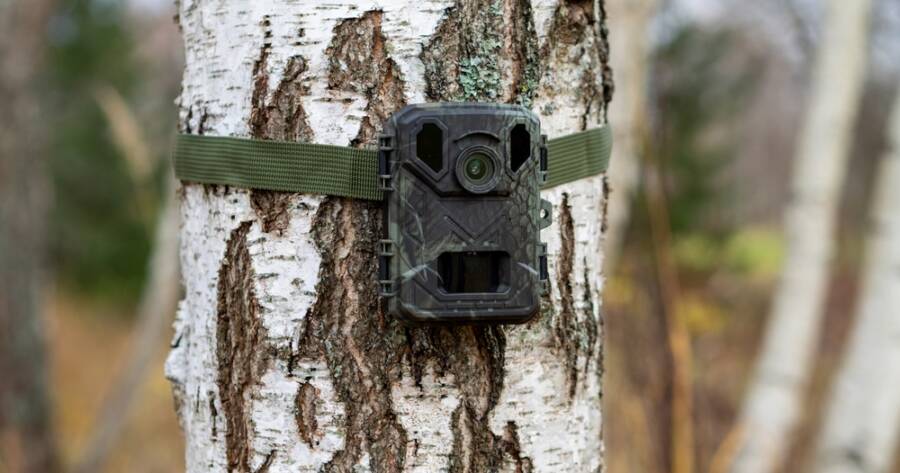
Trail cameras reveal a side of the natural world that people rarely get to witness firsthand. After sunset, raccoons, foxes, deer, owls, bobcats, and other wildlife may move through forests, fields, and even backyards unnoticed. Modern infrared cameras can document those visits with minimal disturbance, offering fascinating glimpses into nighttime behavior, travel patterns, and unexpected animal encounters.
What Happens After Dark in the Wild
The hours between dusk and dawn belong to wildlife. Deer move quietly through clearings, foxes trot along fence lines, owls glide low over meadows, and raccoons investigate anything that catches their attention. Most wildlife activity happens in complete darkness, making night vision trail cameras essential for capturing these moments (source). Without a camera quietly stationed along a trail or near a water source, these behaviors remain invisible to human observers.
Trail cameras have become invaluable tools for photographers, conservationists, researchers, and anyone curious about what roams after dark (source). A single camera deployed in the right location can produce weeks of footage revealing species diversity, travel patterns, feeding habits, and even rare encounters between predators and prey that no human observer could document in person.
Wildlife You Might Capture After Dark
The animals that appear on a trail camera depend heavily on location, habitat, season, and where the camera is positioned. In wooded or suburban areas, common nighttime visitors can include raccoons, opossums, foxes, coyotes, skunks, and deer. Bobcats may also appear in regions where they are established, while owls and other nocturnal birds can occasionally be recorded near open clearings, woodland edges, or water sources.
Trail cameras can also reveal animals that people rarely notice even when they live nearby. A camera placed along a game trail, near a pond, or beside a natural travel corridor might capture several species using the same area at different times of night. Because activity patterns vary throughout the year, leaving a camera in place for several weeks can provide a much broader picture of the wildlife moving through a property.
The Technology That Makes Night Vision Possible
The secret behind trail camera night vision lies in infrared light. When motion triggers the camera, it emits infrared light at wavelengths of 850nm or 940nm that function like a flashlight only the camera itself can detect (source). Human eyes cannot perceive this light, and some animals are equally unaware of it. This means the camera silently illuminates the scene and records it while the animal continues to behave naturally.
Infrared trail cameras produce no visible flash, no audible sound, and minimal red glow, which allows animals to behave naturally and enables accurate wildlife behavior tracking (source). This is a significant advantage over older flash-based camera trap designs, which could startle animals and alter the very behavior researchers were hoping to study.
Some advanced models take nighttime imaging even further by incorporating starlight sensors. Rather than relying solely on infrared LEDs, starlight night vision captures color images during periods of moonlight or dusk, delivering higher detail and realism compared to traditional black-and-white infrared imaging (source). The result is footage that looks closer to what the human eye would perceive under low-light conditions, offering a more immersive look at nocturnal wildlife.
How Animals Actually Respond to Trail Cameras
While the invisibility of infrared technology is impressive, scientific research adds important nuance to how animals interact with camera traps. Studies have demonstrated that camera traps produce sounds that fall well within the hearing range of most mammals and emit illumination detectable by many species (source). In other words, “no glow” does not necessarily mean completely undetectable to every animal in every situation.
Research has shown that some mustelids, such as weasels and otters, may detect infrared light at wavelengths up to 870nm, raising questions about whether no-glow cameras are truly invisible to all animals (source). Studies using older xenon flash devices found that tiger capture rates in Nepal dropped by half over just five nights of camera trapping, showing how light emissions from cameras can alter nocturnal behavior (source). Choosing the right camera model and placement strategy matters considerably for both wildlife wellbeing and data quality.
Choosing the Right Trail Camera for Nighttime Use
Not all trail cameras perform equally after dark. The Bushnell Core DS-4K No Glow, for example, uses a dual-sensor design with a dedicated night sensor capable of producing clear images at distances of up to 110 feet in complete darkness (source). Features like this illustrate how far trail camera engineering has advanced in recent years, with dedicated hardware engineered specifically for low-light performance rather than adapting daytime sensors for nighttime use.
No-glow LED technology is particularly valuable for wildlife observation because the absence of visible light means animals do not react to the camera’s presence, allowing natural behaviors to be recorded on camera (source). Trigger speed, detection range, image resolution, and battery life are all factors worth comparing carefully before deploying a camera in the field.
The Surprises Waiting to Be Discovered
Anyone who has reviewed a memory card after a trail camera’s first night in the field knows the particular excitement of discovering which animals passed through. A trail camera placed near a backyard pond might reveal a family of raccoons, a visiting heron, or a curious fox. A camera positioned along a forest edge might capture a black bear, a bobcat, or a pair of deer sparring in the early morning hours before anyone is awake to witness it.
Camera trapping has become one of the most widely used methods in wildlife research and monitoring, though the considerable variability between models and animal responses to their emissions means thoughtful deployment remains important (source). For hobbyists and researchers alike, the footage that results offers a genuine window into a world that operates entirely on its own schedule, independent of human presence.
Why You Should Learn More About Trail Cameras Today
Trail cameras equipped with modern infrared and starlight night vision technology open a compelling window into wildlife behavior that would otherwise remain hidden. From the silent mechanics of no-glow LEDs to the nuanced science of how animals perceive camera traps, every aspect of this technology rewards deeper exploration. Whether the interest lies in wildlife photography, property monitoring, conservation research, or simple curiosity about local animal activity, trail cameras offer a reliable and non-intrusive way to document the natural world.
Understanding the differences between camera models, sensor types, and placement strategies helps users get the most out of each deployment and ensures animals are affected as little as possible in the process. The nighttime surprises waiting on the next memory card are always worth pursuing.