

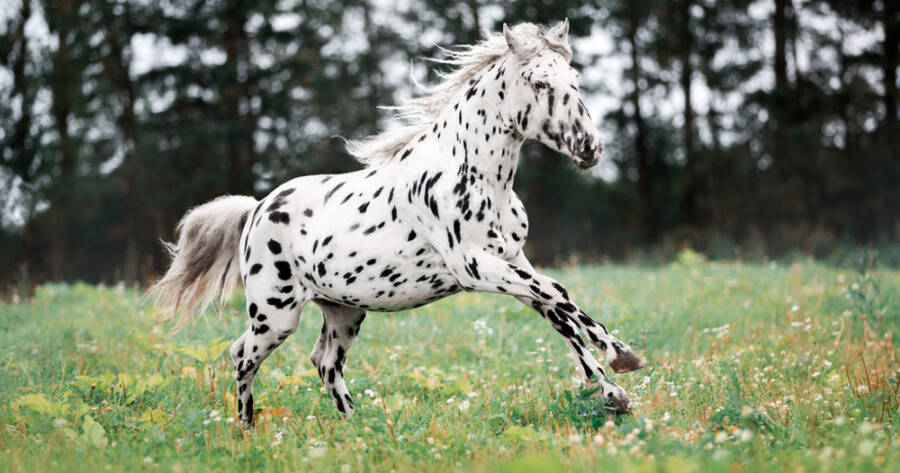
Some horses are memorable not because of their breed, size, or performance record, but because of markings that immediately distinguish them from the herd. Birdcatcher spots, Bend-Or spots, and blood marks are among the more unusual natural coat features seen in horses. Several horses help illustrate just how distinctive the rare patterns can become.
1) Birdcatcher: The Horse Behind Unusual White Spots
Birdcatcher was an Irish Thoroughbred stallion born in 1833 whose name became associated with an unusual form of white spotting. Horses described as having Birdcatcher spots develop small, scattered white areas across an otherwise solid-colored coat. The spots can occur on horses of different colors and may not become visible until later in life.
One of the characteristics that makes these spots especially unusual is their unpredictability. They can appear after a horse has matured, and some may fade or seem to reappear in different locations. They are also distinct from white hairs produced by rubbing, scars, or other damage to the skin. Although the pattern was named for Birdcatcher, researchers have not established a simple breed-specific genetic explanation for it. The characteristic does, however, appear in some related horses, suggesting heredity may play a role (source).
That makes a horse with Birdcatcher spotting particularly interesting to follow over time. Unlike a familiar blaze or stocking that remains recognizable throughout life, these small white areas can make the coat look subtly different as the horse ages.
2) Bend Or: Dark Spots on a Chestnut Coat
Another famous Thoroughbred gave his name to almost the opposite effect. Bend Or, a chestnut stallion foaled in 1877, became associated with dark areas now commonly known as Bend-Or spots. Instead of adding white to the coat, these markings appear as darker patches against a lighter background.
Bend-Or spots are most noticeable on colors such as chestnut and palomino, where the contrast can make an individual patch look almost like a dark stain. They may be relatively small or cover a larger section of the body, and they do not necessarily appear when a horse is young. Some become visible only after the horse has aged for several years (source).
The markings take their name from Bend Or because the Thoroughbred displayed dark spotting himself and had similarly marked horses in his pedigree. Their precise biological cause remains less clearly understood than many established equine coat-color patterns. For an owner, that uncertainty is part of what makes the markings so striking: a young horse with an apparently uniform coat can later develop a feature that becomes one of its most recognizable characteristics.
3) WH Justice: A Dramatic Blood Mark
Rare markings are not limited to dark and white spots. Gray horses can occasionally develop areas commonly called blood marks or bloody shoulder markings. These patches retain reddish or chestnut coloring while the surrounding coat becomes progressively lighter with the normal graying process.
A particularly striking example is the Arabian stallion WH Justice, whose blood mark extends across a significant portion of his neck and onto part of his face (source). The contrast between the reddish marking and the lighter gray coat makes the pattern immediately noticeable.
Blood marks are associated with gray horses and can occur on different areas of the body, despite the alternative name “bloody shoulder.” They are considered unusual to rare, and some may become more prominent as the horse ages (source). They should not be confused with an injury or actual staining of the hair. Instead, the color is part of the horse’s natural coat.
Why These Markings Stand Out
Birdcatcher, Bend Or, and WH Justice demonstrate three very different ways unusual pigmentation can transform a horse’s appearance. Birdcatcher is associated with scattered white spotting, Bend Or with darker patches on a chestnut coat, and WH Justice provides a dramatic example of reddish pigmentation remaining within a graying coat.
These markings are especially fascinating because they do not always behave like familiar facial and leg markings. Some emerge later, some become more noticeable with age, and others may change in appearance as the surrounding coat changes. That can make identifying them more complicated than simply looking at a foal and recording its markings once.
Why You Should Learn More About Rare Horse Markings
Rare natural markings offer a visible reminder of how much variation exists within the equine coat. They can also preserve links to individual horses whose distinctive appearances became associated with the patterns themselves.
Birdcatcher and Bend Or gave their names to markings still recognized generations later, while WH Justice shows what an unusually extensive blood mark can look like on a living horse. Whether the result is scattered white spots, dark patches, or a reddish area against a gray coat, these markings can turn an already individual animal into a horse that is difficult to forget.