

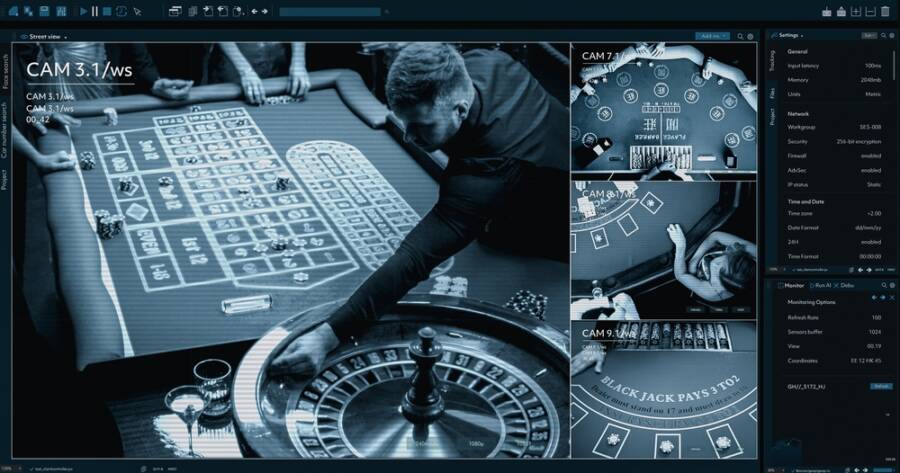
Casino surveillance cameras record much more than general activity on the gaming floor. They can capture guests’ faces, movements, visible wagers, and interactions with employees. Some establishments also use advanced software to analyze footage and identify potential security concerns. Understanding what cameras actually record, and what technology can determine from those recordings, reveals how closely casino activity may be monitored.
Where Casino Surveillance Cameras Are Located
Casino surveillance systems monitor areas where gaming, financial transactions, and security-sensitive activities occur. Cameras are commonly positioned above gaming tables, around slot machines, near entrances, and in cashier areas. Additional equipment may cover corridors, restaurants, bars, and employee-only spaces.
Different locations require different types of coverage. Wide-angle cameras capture activity across crowded areas, while high-resolution equipment can provide closer views of specific interactions. However, camera placement, lighting, and physical obstructions can affect visibility. Even sophisticated surveillance networks cannot guarantee that every movement is recorded (source).
What Cameras Record at Gaming Tables
Gaming tables receive particular attention because casinos must monitor wagers, game procedures, and interactions between dealers and players. Depending on camera positioning, recordings may reveal how cards are distributed, where chips are placed, and whether participants follow established gaming procedures.
If a player disputes a payout, surveillance personnel can review footage to reconstruct the visible sequence of events. Recordings may also help investigate suspicious gestures, chip manipulation, or irregular dealer behavior. However, unusual activity does not automatically establish cheating, and footage must be interpreted within the circumstances of each incident (source).
How Cameras Monitor Slot Machines and Cash Transactions
Cameras around slot machines can document guests approaching equipment, handling cash or tickets, interacting with controls, and leaving gaming areas. Such recordings may help resolve disputes or investigate potential theft. However, precise wagering information and account balances generally come from electronic gaming records rather than video footage alone.
Cashier windows and other money-handling locations also receive close attention. Surveillance footage can document visible exchanges involving currency, chips, or payment documents. When discrepancies arise, investigators may compare recordings with financial transaction records to understand what occurred. Cameras provide valuable visual evidence, but they do not necessarily reveal every detail of a transaction.
Can Casino Cameras Identify Individual Guests?
High-resolution cameras can capture recognizable facial features, clothing, physical characteristics, and movements through monitored spaces. These details may help security personnel identify individuals involved in particular incidents or review their activity across different areas of a casino.
Some establishments also use facial recognition software to compare captured images with stored photographs, potentially identifying people who have previously been excluded from a property. However, this technology is not universally deployed, and results can be affected by lighting, camera angles, and image quality. Possible matches require appropriate evaluation rather than being treated as definitive identification (source).
What Artificial Intelligence Can Detect
Artificial intelligence can help surveillance teams examine large amounts of video and identify activity that warrants closer attention. Depending on the system, software may highlight unusual movements, recurring interactions, or patterns that differ from expected behavior.
For example, analytical tools might identify repeated contact between certain individuals or unexpected activity around gaming equipment. Nevertheless, these observations do not prove wrongdoing. Cameras primarily capture visual information, while analyzing detailed betting patterns may require additional data from gaming systems. AI capabilities vary between properties, and human judgment remains essential when evaluating alerts (source).
How Long Do Casinos Keep Surveillance Footage?
Casino recordings are not necessarily retained indefinitely. Storage periods depend on state regulations, the type of footage, and individual casino policies. Properties may also preserve certain recordings longer when they relate to an investigation or unresolved incident.
In Nevada, surveillance standards amended in April 2026 generally require specified recordings to be retained for at least seven days until April 3, 2027, when the minimum increases to fifteen days (source). Certain recordings involving security detentions or questioning have longer retention requirements. Other jurisdictions establish their own rules, so storage periods can differ considerably.
Why Human Surveillance Teams Remain Important
Despite advances in cameras and analytical software, trained surveillance personnel remain central to casino security. Operators review recordings, investigate alerts, and examine incidents within their broader context. They may also coordinate with security departments and gaming regulators when circumstances require further investigation.
Their responsibilities extend beyond identifying potential cheating. Surveillance teams help investigate theft, resolve customer disputes, document incidents, and support regulatory compliance. Technology assists these activities, but determining what actually occurred often requires human interpretation and additional evidence.
What Casino Guests Should Understand About Surveillance
Casino cameras can capture detailed visual records of guests’ appearances, movements, gaming interactions, and transactions in monitored areas. Some properties supplement these recordings with facial recognition or AI-assisted analysis to help identify potential security concerns.
However, surveillance capabilities differ between casinos, and video footage cannot automatically establish someone’s intentions or reveal every aspect of their behavior. Understanding the distinction between what cameras record and what software may infer provides a more accurate picture of casino surveillance and how recorded information can be used.